
- today
- label News
- favorite 0 likes
- remove_red_eye 3537 views
- comment 0 comments
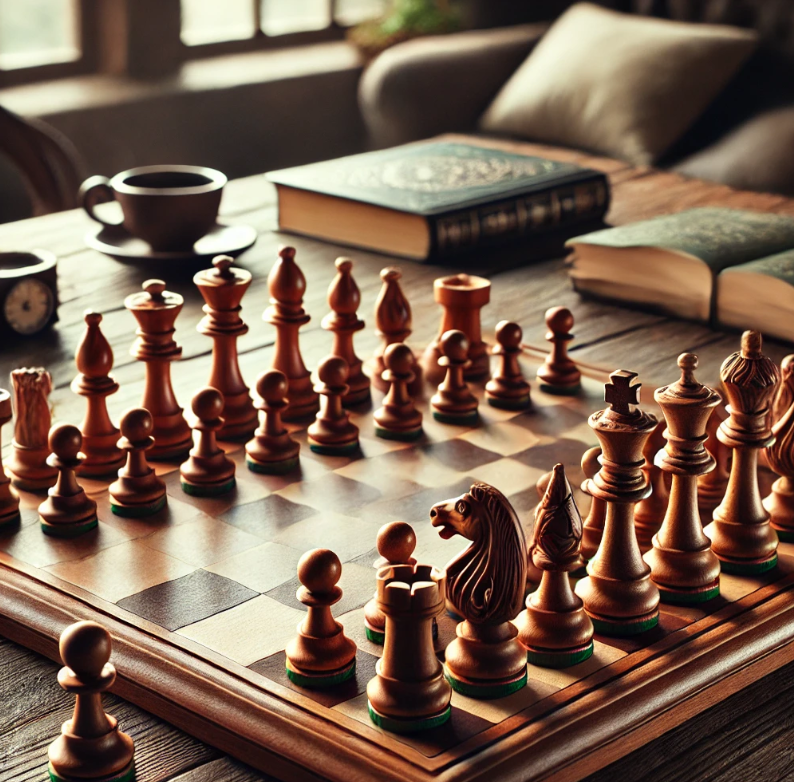
Learning to Play Chess – A Beginner's Guide
"Chess is a sea in which a gnat may drink and an elephant may bathe." – Indian Proverb
Chess is not just a board game; it is a true art that develops logical thinking, patience, and planning skills. Regardless of age or skill level, chess can become a fascinating way to spend free time. In this article, we will introduce the rules of chess, the names of the pieces, and tips on choosing the right chess set.
Basic Rules of Chess
Chess is played on an 8x8 board with alternating white and black squares. Each player starts with 16 pieces:
-
King – the most important piece; moves one square in any direction.
-
Queen – the most powerful piece; moves in any direction along straight lines and diagonals.
-
Rook – moves in a straight line, horizontally or vertically.
-
Bishop – moves diagonally, only on squares of one color.
-
Knight – jumps over pieces in an "L" shape (two squares in one direction and one in another).
-
Pawn – moves forward one square, captures diagonally.
Objective: The goal is to checkmate the opponent's king, meaning it cannot make any legal move to avoid capture.
How to Choose Chess Sets?
When choosing a chess set, consider several key factors:
-
Material
-
Wooden chess sets – a classic choice, ideal for lovers of tradition and aesthetics.
-
Plastic chess sets – lightweight and durable, great for travel and everyday use.
-
Metal chess sets – elegant and heavier, often used for decoration.
-
-
Board and piece size
-
Beginners should choose a standard size (approx. 50x50 cm with pieces 9-10 cm high).
-
For travel, consider smaller, foldable magnetic sets.
-
-
Chess styles
-
Tournament – compliant with official FIDE standards.
-
Decorative – richly decorated, often with historical elements.
-
-
Chess for children
-
Should be made from safe materials and feature markings to help learn moves.
-
Practical Tips for Beginners
-
Learn the basic rules – understand how each piece moves before playing.
-
Start with simple combinations – focus on basic checkmating patterns (e.g., checkmate with two rooks).
-
Avoid weak moves – do not expose pieces to capture without purpose.
-
Practice regularly – play with others, solve chess puzzles, and analyze games.
-
Control the center – occupying central squares provides a strategic advantage.
-
Take your time – every move should be well thought out.
Conclusion
Learning to play chess is an exciting journey that can provide great satisfaction and intellectual benefits. By choosing the right chess set and playing regularly, you can quickly improve your skills. Whether you play recreationally or plan to participate in tournaments, chess is an excellent way to develop the mind.
We invite you to explore our range of wooden chess sets, available in various styles and sizes at holzecke.ch. Find your perfect set and start your chess adventure today!
Comments (0)